Comparison
AIPhoto-Generator vs Leonardo AI
Leonardo AI is a Canva-owned image and video platform with its own models, many third-party ones, editing, upscaling and model training; it needs an account, and free-plan images are public. AIPhoto-Generator does one thing, turning text into a realistic photo, with 3 free images and no account, then packs or a monthly plan, and no public gallery.
Last updated
The main differences
- Account and privacy: Leonardo needs an account, and its free-plan images are public and can be indexed by search engines; AIPhoto-Generator needs no account for the free images and has no gallery.
- Free images: Leonardo's terms and pricing FAQ both say Leonardo owns free-plan outputs; the pricing FAQ adds a commercial license for free users that the terms don't mention. Our Terms set the same image rules for free and paid images.
- Range: Leonardo offers many models, reference images, a canvas editor, upscaling to 105 MP and personal model training; AIPhoto-Generator has one model and takes text only.
- Paying: Leonardo's plans are token subscriptions; AIPhoto-Generator sells packs from $5 whose images don't expire, or a monthly plan.
Side by side, fact by fact
Each Leonardo AI fact links to its source.
Swipe the table sideways to see all columns.
| Fact | AIPhoto-Generator | Leonardo AI |
|---|---|---|
| Free use | 3 free images in total, with no sign-up; they don't resetSource: pricing | 150 fast tokens a day on the free plan; unused tokens don't carry overSource: leonardo.ai |
| Account to generate | Not for the 3 free imagesSource: pricing | Yes: its terms require an accountSource: leonardo.ai |
| Paid plans | Starter $5 for 100 images, Creator $15 for 400, Pro $9/month for 300Source: pricing | Essential $12, Premium $30 or Ultimate $60 a month; up to 20% off yearlySource: leonardo.ai |
| How you pay | One-time image packs whose images don't expire, or a monthly plan where unused images roll overSource: pricing | Monthly token subscriptions, with a rollover bank of up to three monthsSource: intercom.help |
| What you can give it | A text prompt only: no photo upload, editing or upscalingSource: About | Text and reference images: up to 6 with Nano Banana on paid plans, 1 on the free planSource: intercom.help |
| Models | One model: Moda lists it as “NanoBanana 2 Lite”, with “gemini” as its providerSource: About | Its own Lucid and Phoenix models plus third-party ones such as GPT Image and Nano BananaSource: leonardo.ai |
| Output size | A PNG of about 1 megapixel; one per prompt on the free plan, up to 4 on paid plansSource: aspect ratio guide | Varies by model; its Pro Upscaler reaches 105 MP on paid plansSource: intercom.help |
| Aspect ratios | 1:1, 4:5, 3:4, 3:2, 16:9 and 9:16Source: aspect ratio guide | Set per model under Image DimensionsSource: intercom.help |
| Are images public? | No public gallery: each image is delivered to you by link, and links may expireSource: Privacy Policy | Public by default on the free plan; private mode on paid plansSource: leonardo.ai |
| Using the images | We don't claim ownership of your images; use is subject to our Terms and the model provider's termsSource: Terms | Leonardo owns free-plan outputs, though its pricing FAQ grants free users a commercial license; paid users own theirsSource: leonardo.ai |
| Watermark | We don't add a visible watermarkSource: realism guide | Not stated for images; free-plan videos carry a watermarkSource: intercom.help |
| Where it runs | Any web browser, desktop or mobileSource: generator | Web, iOS and Android apps, and a separate API with its own creditsSource: intercom.help |
Facts about Leonardo AI come from its own public pages, last checked .
What Leonardo AI offers that we don't
These come from Leonardo AI's own pages; we haven't tested them hands-on.
- Third-party image models such as GPT Image 2 and Nano Banana 2 sit beside its own Lucid Origin. (source)
- Premium and Ultimate keep generating at a slower pace on selected models after tokens run out. (source)
- Paid plans can train personal models on your own images: 10, 20 or 50 a month. (source)
- A canvas editor with inpainting and outpainting. (source)
- A Pro Upscaler that reaches 105 MP on paid plans. (source)
What AIPhoto-Generator does differently
Our default Photorealistic style adds natural lighting, sharp focus and high detail to every prompt. This hillside town at blue hour came from the prompt below with that style.
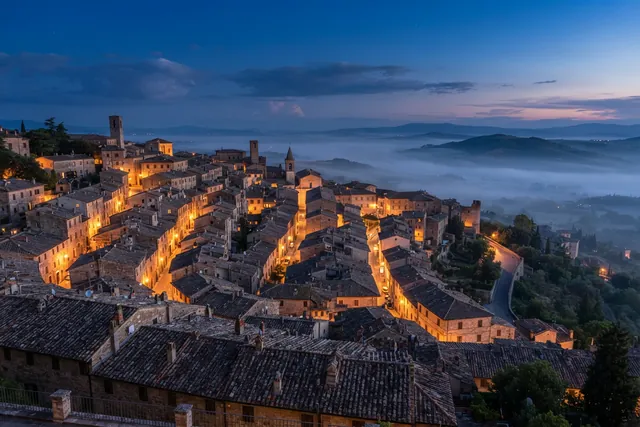
Prompt: Terracotta rooftops of an old hillside town at blue hour, warm lights in a few windows, soft mist in the valley beyond
Real result · Photorealistic · 3:2 · more about this image: Hillside rooftops at blue hour
Which one to choose
Choose Leonardo AI if…
- You want to switch between many models, including third-party ones.
- You need editing, reference images or upscaling for large prints.
- You want to train a model on your own images.
- You'd use the iOS or Android apps, or an API.
Choose AIPhoto-Generator if…
- You want to try it without creating an account.
- You don't want your free images to be public.
- You'd rather pay once for images than manage monthly tokens.
- You want a simple tool: a prompt, a style and a shape.
Leonardo AI is a trademark of its owner. AIPhoto-Generator isn't affiliated with it. How we compare
Questions
Is Leonardo AI free?
Its free plan gives 150 fast tokens a day, which don't carry over; how many images that makes depends on the model. Images made on the free plan are public.
Are Leonardo AI images public?
On the free plan, yes: its privacy policy says everything you generate is public by default and can be indexed by search engines. Private mode needs a paid plan.
Can I use free Leonardo AI images commercially?
Its pricing FAQ and help center say yes: free users get a non-exclusive, royalty-free license for commercial use. Leonardo still owns images made on the free plan, as both that FAQ and its terms of service say, and the terms don't mention the license. Paid subscribers own what they create.
Who owns Leonardo AI?
Leonardo.Ai describes itself as a Canva brand. Canva's own image generator is compared in AIPhoto-Generator vs Canva.